

◆ Chalkbird Inc. · Awareness ◆
What is VEDS?
Vascular Ehlers-Danlos Syndrome is rare, silent, and often deadly — but it doesn't have to be. Awareness changes everything.
◆ Understanding VEDS ◆
Vascular Ehlers-Danlos Syndrome (VEDS) is a rare genetic condition that weakens the tissue holding your body together. Specifically, it affects a protein called Type III collagen — the structural material that gives strength to your blood vessels, organs, and skin.
When that collagen is defective, the consequences can be devastating. Arteries can rupture without warning. Organs can tear. And because VEDS is so rare, and its symptoms so often mistaken for something else, most people who have it don't know until they're already in an emergency room.
VEDS is caused by a mutation in a single gene called COL3A1, and it's passed down through families. If one parent has it, each child has a 50% chance of inheriting it. That means entire family trees can be quietly affected for generations before anyone connects the dots.
◆ Could It Be You? ◆
The signs that most people never notice.
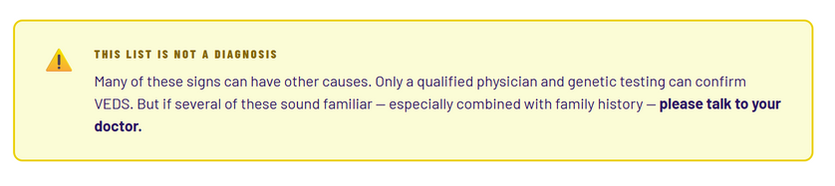
VEDS hides in plain sight. Many of its symptoms are things people live with their whole lives without ever wondering if something deeper is going on. The signs below aren't a diagnosis, only genetic testing can confirm VEDS, but if several of them sound familiar, it's worth asking your doctor about it.
Physical Signs You Can See
🩸
Thin, translucent skin
Your veins are unusually visible beneath the skin — especially on your chest, abdomen, or limbs.
👁️
Distinctive facial features
Large or prominent eyes, a thin or narrow nose, a small or receding chin, and thin lips.
😴
Sleeping with eyes open
A lesser-known but very real sign — some people with VEDS sleep with their eyes partially open due to the way the disease affects connective tissue.
🩸
Unusual bruising
Bruises appear easily, often from very minor bumps — or sometimes with no remembered cause at all.
The Family History Question
This may be the most important sign of all, and the one most often missed. If your family has a pattern of unexplained early deaths, especially those chalked up to "heart attacks" or "sudden illness" in people under 60, it's worth asking why.
◆ Why Awareness Matters ◆
The difference between knowing and not knowing is everything.
VEDS is dangerous. But the real killer isn't the disease itself — it's the lack of awareness around it. Patients who don't know they have VEDS can't protect themselves. First responders who don't recognize it can't treat it correctly. And families who don't know it runs in their blood can't get tested.
◆ Without Awareness
Unknown. Untreated. Unprepared.
Average life expectancy for undiagnosed VEDS patients can be in the mid-40s. Emergency response may apply standard protocols — including medications like blood thinners — that can be harmful to a VEDS patient. Families lose generation after generation to "heart attacks" that were never heart attacks.
◆ With Awareness
Known. Monitored. Protected.
Early diagnosis enables regular imaging to catch problems before they become emergencies. Patients can be referred to vascular specialists. Family members can be tested. First responders trained in VEDS can adjust their response. Lives can be saved — and often are.
◆ If You Suspect VEDS ◆
Here's what to do — step by step.
If anything on this page felt familiar — the symptoms, the physical signs, the family history — don't ignore it. Early knowledge is the single most powerful protection against VEDS. Here's exactly how to move forward.
Write down what you've noticed.
1
Before you talk to a doctor, make a list. Include which physical signs you have, what symptoms you've experienced, and any family history of sudden or unexplained deaths — especially heart attacks, aortic issues, or unexplained deaths in people under 60.
Why this matters: Doctors have limited time. A clear, prepared list dramatically improves your chances of being taken seriously on the first visit.
Talk to your primary care doctor.
2
Bring your list. Ask directly: "Could this be a connective tissue disorder — specifically Vascular Ehlers-Danlos Syndrome?" Request a referral to a geneticist or a cardiologist familiar with heritable connective tissue disorders.
Why this matters: Most primary care doctors haven't seen a VEDS case. Using the specific name signals to them that you've done your research — and gets you referred faster.
Request genetic testing for COL3A1.
3
VEDS is confirmed through a blood or saliva test that looks for mutations in the COL3A1 gene. This is usually done through a medical geneticist. Testing is definitive — you either have the mutation or you don't.
Why this matters: Testing is the only way to know for sure. Insurance often covers it when there's clinical suspicion or family history.
If positive, build your care team.
4
A confirmed diagnosis should lead to a specialist team — typically a vascular surgeon, cardiologist, geneticist, and genetic counselor. You'll want regular imaging (usually annual) to monitor your blood vessels and organs.
Why this matters: VEDS is manageable with the right monitoring. Most emergencies are preventable when caught early.
Tell your family.
5
This is the hardest step, and the most important. VEDS is genetic. Every blood relative — parents, siblings, children, aunts, uncles, cousins — has a potential risk. They deserve to know so they can decide whether to be tested themselves.
Why this matters: Your diagnosis could save their life. Every family member who gets tested is another life potentially protected from a silent killer.

You don't have to face this alone
Whether you're looking for more information, need help finding a specialist, or want to connect with someone who's lived this — Chalkbird is here. Reach out. We'll do everything we can to help.